What Do WRP Alumni Do?
Graduates of the Water Resources program enjoy a wide range of employment opportunities. These fall into four categories, all of which employ one or more MWR alumni:
1. Public resource management agencies including federal (US Bureau of Reclamation, US National Park Service, US Forest Service, US Fish and Wildlife Service, US Geological Survey), state (NM Environment Department, NM Office of the State Engineer), and local (Middle Rio Grande Conservancy District, Albuquerque Bernalillo County Water Utility Authority, City of Santa Fe).
2. Consulting firms, which often provide consulting services to federal, state, and local water resource management agencies. Many of these firms also provide consulting services to industries and other entities that are large users of water.
3. Private industries and other entities that use large amounts of water such as electric power, mining, and agricultural businesses
4. Further graduate education leading to a Ph.D. degree or professional degrees in fields such as law, engineering, or public health.
Alumni Highlights
Emily Wolf
I grew up a devoted hiker, swimmer, kayaker, and love exploring the mountains, rivers, and arroyos of New Mexico. I received my master’s degree in water resources/hydroscience from the University of New Mexico’s Water Resources Program, and worked with the Civil Engineering Department on water quality and nutrient uptake analysis. I have worked most closely on erosion mitigation and river, watershed, and restoration issues on landscapes and with diverse communities across New Mexico and Colorado since graduating from UNM, and have focused on outdoor education, community science, restoration, and policy issues with American Rivers, the National Parks Conservation Association, the Audubon Society, and the Rio Puerco Alliance.
What advice would you give to students pursuing a career in water resource management?
Water is a resource that, of course, every community has an incredibly deep and distinctive relationship with. In this field, connecting with people and putting relationships first has been critical for me.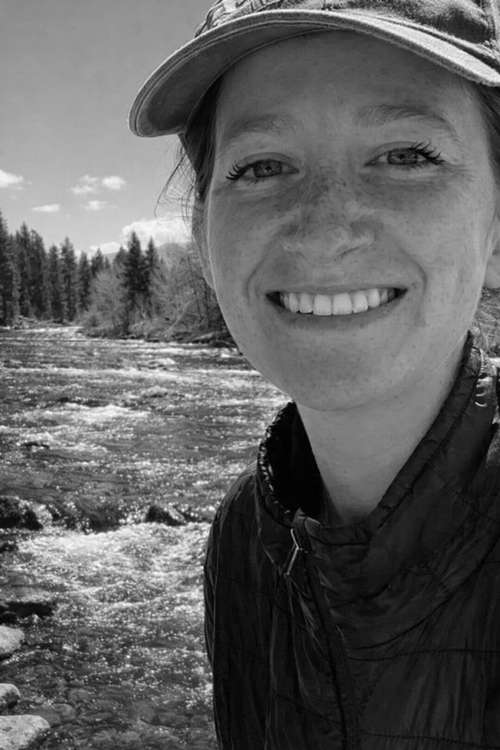
What are the most valuable things you learned during your academic career at UNM?
The multi-disciplinary breadth of information and knowledge we received in the Water Resources Program was crucial – gaining skills and knowledge in water law, engineering, field watershed science, and water management (and more) gave a full and holistic picture of the complexities of integrated water and watershed management.
How have you applied what you learned in the water resources program to your professional career? Are there any stories or anecdotes you would like to highlight?
Yes, I use what I learned in the program every day! Studying post-fire watershed conditions at UNM has directly connected with planning and implementing post-fire restoration work at American Rivers.
Contact: Emily.kwolf26@gmail.com, www.linkedin.com/in/emily-wolf-06216844/
Ryan Kelly
A native of Albuquerque, Ryan discovered his passion for water science through UNM Professor Cliff Dahm’s Limnology course. This inspiration led him to earn a B.S. in Biology in 2013 and a Master of Water Resources in 2016 from UNM. Since 2016, he has worked for the Nebraska Department of Natural Resources, where he applies his expertise in hydrology, hydraulics, and policy to water resource management.
What advice would you give to students pursuing a career in water resource management?
I would advise students to diversify their coursework, as success in the field requires balancing scientific knowledge with an understanding of policy and stakeholder engagement. I’d also emphasize the importance of building relationships, as collaboration plays a crucial role in addressing water challenges.
What are the most valuable things you learned during your academic career at UNM?
For me, the most valuable lessons from UNM extend beyond technical knowledge. While coursework provided the foundation for my expertise, the friendships and professional networks I built at UNM were just as essential in shaping my career.
How have you applied what you learned in the water resources program to your professional career? Are there any stories or anecdotes you would like to highlight?
Throughout my career, I’ve applied my education to real-world issues, including delineating FEMA floodplains, working on groundwater and surface water modeling, and engaging in interstate water agreements. My experience with stakeholder communication and policy implementation has allowed me to serve as a subcommittee chair on the North Platte Decree Committee and contribute to the Platte River Recovery Implementation Program, highlighting the intersection of science and policy in managing water resources effectively.
Contact: ryan.kelly@nebraska.gov
Kate Lacey-Younge
 Kate Lacey-Younge earned her Bachelor of Science degree in Natural Resources with an emphasis in Watershed Management and Hydrology from the University of Arizona in 2011 and earned a Master of Water Resources degree, graduating with distinction, with a concentration in Hydroscience from UNM in 2017. Her professional project focused on diatoms found in travertine-precipitating springs in the Sandia Mountains, where she worked closely with Director Becky Bixby to learn the art of diatom identification.
During Kate’s career, she has worked with local, state, and federal agencies to manage and protect New Mexico’s water resources, including experience in watershed restoration and management, water rights, post-fire mitigation work, nonpoint source management, and fire management. As the Watershed Protection Section Program Manager with the Surface Water Quality Bureau of the New Mexico Environment Department, Kate manages an array of responsibilities aimed at safeguarding New Mexico’s surface water quality. She currently oversees multiple funding sources and grants, facilitating contracts to improve surface water quality and riparian ecosystems through nonpoint source management across New Mexico. Prior to her tenure with the Surface Water Quality Bureau, Kate worked with the Albuquerque Bernalillo County Water Utility Authority (ABCWUA) where she focused on water resources management and water quality protection, including the management of the Bear Canyon Aquifer Storage and Recovery Project and work with the Middle Rio Grande Endangered Species Collaborative Program. Preceding her time at ABCWUA, she worked in fire management and watershed management with the Cibola National Forest for several years working on fire crews, post-fire mitigation projects and teams, and in watershed management. Kate worked towards her Master of Water Resources while employed with the Cibola National Forest, gaining experience in the professional world while advancing her education.
What advice would you give to students pursuing a career in water resource management?
It is imperative to gain experience in the field while you’re earning your degree. Not only will the experience help you decide what area of water resources management you are most interested in (e.g., water quality or water quantity), but it will help you stand out as an applicant for employment after you graduate.
Also, as soon as you start your MWR program, try to identify a professional project and a committee. If you’re working in the water resources field or in an internship, see if there’s a real-world problem that needs a solution that could be turned into a professional project and find a professor that has related interests to serve as a mentor and on the committee. Your motivation and passion towards a project will be the ultimate driver of your success in the MWR program.
What are the most valuable things you learned during your academic career at UNM?
Hard work, passion, and dedication to your education and career pay off. Taking the time to learn about different career paths in water resources management and making connections with staff, agencies, and your peers while you’re in school will help you be successful beyond your time at UNM.
Contact: Kathryn.lacey@env.nm.gov
Lucas Curry
 Prior to studying in the Water Resources Program at UNM, Lucas Curry received his B.S. in Environmental Engineering from the Georgia Institute of Technology and then served in the Peace Corps in Panama from 2012 to 2014. He lived in a remote, indigenous village, working on potable water and sanitation projects and hiking all over the Panamanian mountains with his dog, Cache. After returning from Panama, Lucas and Cache moved to the Southwest and traded tropical humidity for the desert. He attended UNM from 2015 to 2017 where he was enrolled in the dual Water Resources/Community & Regional Planning Program while working as a hydrologist for the USGS New Mexico Water Science Center.
Lucas’s work at the USGS focused on mapping the Albuquerque aquifer and he was able to expand that work into a professional project at UNM. After graduating, Lucas returned to Atlanta and worked as a Water Resources Engineer for the consulting firm, Tetra Tech, for 4.5 years. He designed stormwater management and stream restoration projects, assessed dams and prepared dam emergency action plans, prepared hydraulic and hydrologic models, and had the opportunity to design the conversion of an 80+ acre piece of neglected land into a restored wetland and recreational area.
Since 2023, Lucas has been working as a Watershed Restoration Engineer with The Nature Conservancy in Tennessee. He partners with two federal agencies, the U.S. Forest Service and the Natural Resources Conservation Service, to design and implement Aquatic Organism Passage (AOP) projects around the Cherokee National Forest in the southern Appalachians. This region is one of the most biodiverse temperate regions of the world with hundreds of species of fish and other aquatic organisms that depend on connected stream habitat for survival. Lucas works to remove aging and failing culverts that create barriers to aquatic organism passage and replaces them with bridges or enlarged bottomless culverts that allow streams to continue flowing without any barriers.
What advice would you give to students pursuing a career in water resource management?
I would suggest that students get involved in water resource management organizations and attend organization meetings. The water resources network is close-knit and there are diverse opportunities in this field, so figuring out what interests you, showing up, and meeting people will open many doors for you.
I’d also suggest finding work opportunities that will provide you with ideas for your professional project. Getting paid to complete your master’s degree is a win-win.
What are the most valuable things you learned during your academic career at UNM?
Science Communication. It does not come naturally to me, but the Water Resources Program helped me recognize the importance of it. You can have data, you can engineer things, but you must also be able to communicate your work with the public.
Contact: curry.lucas@gmail.com, www.linkedin.com/in/lucas-curry