Dr. Michael Campana (1948-2024)
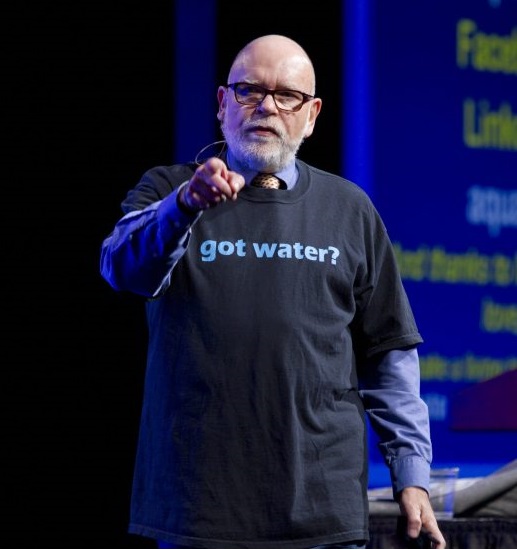
With heavy hearts, we remember Dr. Michael Campana, former faculty in Earth & Planetary Sciences and Director of the Water Resources Program at the University of New Mexico. Michael died on August 25, 2024 from injuries related to a car accident. Dr. Campana served on the faculty of UNM from 1989 to 2009, and directed the Water Resources Program from 1997 to 2006. He is remembered for his contributions to the field of transboundary groundwater resources, sustainable water resources management, water, sanitation and hygiene (WaSH) in developing regions, and science-policy interface.
After a long and successful career at UNM, he taught at Oregon State University from 2009 until his retirement in 2023. He also served as Chair of the American Water Resources Association (AWRA), and founder of the nonprofit Ann Campana Judge Foundation, among numerous other achievements. He is remembered by his colleagues and students for his passion, committment, and expertise in the field of water resources.
Remembrances
"One of Michael's biggest contributions to UNM was his service to and leadership of the Water Resources Program. He became Director in 1997 and took over a program that was poorly funded with few students and over the course of just a few years, he built it into a thriving academic enterprise with enthusiastic collaboration from faculty, staff, and students in five different schools and colleges. The diversity of interests and opportunities available through the program attracted students with wide ranging backgrounds including the physical and biological sciences, engineering, public health, law, policy, and planning, social sciences and even some with a background in the arts.
One of the most notable experiences in the Water Resources Program during Campana’s time as director, was the summer course titled 'Water Resources Methods' which consisted of several weeks studying water challenges with Campana in developing countries, most often in Latin America. These field studies, primarily funded by donations from Michael and Mary Frances, his spouse, are widely cited by alumni as the most intellectually stimulating part of their graduate education.
Michael played a huge role in training and educating water management leaders in the southwest and beyond. And though he left New Mexico for the wetter climate of Oregon, he retained strong interest and affection for the people, culture, and students of New Mexico."
-Dr. Bruce Thomson, former Water Resources Director and Professor Emeritus, Civil, Construction, and Environmental Engineering, University of New Mexico
"Dr. Michael Campana joined the University of New Mexico (UNM) faculty in the fall of 1989. Early on during his time at UNM, he became interested in an emerging national and international area of interdisciplinary scientific research focused on the interactions of groundwater and surface water. This interdisciplinary group of UNM faculty, postdoctoral researchers, and graduate students successfully competed for National Science Foundation (NSF) support from 1991 to 1999. Mike’s strength in hydrology and hydrologic modeling added to expertise in aquatic biology, biogeochemistry, civil engineering, and geomicrobiology that produced multiple successful NSF research proposals throughout the 1990s.
Mike was an early leader in the study of hyporheic zones. Hyporheic zones are dynamic regions of the landscape where surface waters and groundwaters interact in streams and rivers. These collaborations in the study of hyporheic zones at UNM in the 1990s were a very productive part of Mike’s professional career. In fact, the three most cited research papers in Mike’s career were published in 1996, 1997, and 1998 while at the University of New Mexico. Mike will be warmly remembered by colleagues at UNM for his leadership in the hydrologic sciences and interdisciplinary water resource studies."
-Dr. Cliff Dahm, Professor Emeritus, Department of Biology, University of New Mexico
"Working with Michael Campana was a wonderful privilege. He assumed leadership of the Water Resources Program shortly after I joined the UNM faculty. I served on the WRP's steering committee for most of his tenure there so I could see up close the high esteem in which he was held by WRP students. He and I worked closely to put together the EPS Department's Environmental Science B.S. degree program 25 years ago.
Shortly before Michael departed for greener pastures (literally) in Corvallis, students organized a farewell bash for him at the Albuquerque Aquarium. These water bottles were distributed at the party. The label shows him as Poseidon, dispensing wisdom to the thirsty masses -- presumably in his gruff yet kindly way. The joke here was that Michael despised the economics of bottled water, as pointed out on the label: III. Bottled Water = $1.2M/ac-ft. (And, of course, that cost is in 2009 dollars). I think fondly of my colleague Michael Campana every time I see this bottle on the shelf in my office."
-Dr. David Gutzler, Professor Emeritus, Earth & Planetary Sciences, University of New Mexico
"Michael Campana was one in a million (or more). He was a humanitarian, a scholar, a teacher, a hydrophilanthropist, and an all-around good guy. I had the opportunity to get to know Michael as part of the four person team teaching a water resources class. It was one of the most rewarding courses I’ve ever taught, as the hydrologist, the engineer, the economist, and the communicator worked to provide Water Resource students with the ability to develop interdisciplinary models, understand them, and to communicate the importance of the outcomes to a wide audience. That approach came from Michael’s vision for the program. His commitment to the course and the Water Resources Program were always evident, but what stood out most was his connection to the students. He encouraged, mentored and sometimes pushed his students to succeed. And it was always done with grace, humor, and care.
Michael wrote a blog called Campanastan for several years. It was one of the few that I always read. The topics were diverse and he always made me think and often made me smile as I read his posts. Interwoven through many of his musings was a focus on his family. He loved his family. When Michael’s sister, Anne, was killed on 9-11, Michael’s response was extraordinary. He honored her by starting the Anne Campana Judge Foundation, a non-profit that supports and funds projects in developing countries that broadly focus on water, health and sanitation. Whenever I heard from him, he was always excited about the projects. While not large, these projects literally changed the lives of small villages without running water. I can remember a lengthy conversation with Michael talking about the impact these projects had on the lives of women, when they no longer had to spend hours each day carrying water for basic needs. Instead, the women often used the time making craft items that could be sold, which turned into small businesses, and improved the economic wellbeing of the entire village. These projects brought water and opportunity. What I also remember was Michael’s sheer excitement and joy when he talked about this work.
Trying to write about Michael is difficult because he was so many things to so many people. The world is better for him having been here. I hope that people will honor him by thinking more broadly, finding humor in the ordinary, and by trying to make the world a little better than we found it."
-Dr. Janie Chermak, Professor Emerita, Economics, University of New Mexico
"Michael Campana was a man of vision and energy. He was a consummate producer-director, a genius organizer. He could have organized the NASA moon landing. As director of the UNM Masters of Water Resources Program (MWRP), Michael transformed the program’s capstone course, usually a summer field course centered on a New Mexico river basin, into a life-changing experience for students. For several years beginning in the early 2000s, Michael conducted the field course in rugged mountains on the northwest coast of Honduras, one of the poorest developing countries in the Western hemisphere. I participated as co-instructor in the first four Honduran field courses. There were more. How did he pull this off again and again?
MICHAEL IMAGINED AND PLANNED AND ACTED
Michael’s summer volunteer work on water projects in Central America led him to imagine introducing his grad students to the world he had come to know there. He was sure he could count on help from his Honduran contacts, Rolando Lopez and Alex Uriel del Cid Vasquez. He had met these men through the NGO Lifewater International. Rolando Lopez, a retired family man from Puerto Cortes, was the go-to-guy in his region for introductions, entrée, and logistics of all kinds. Alex had complementary talents. He was an experienced, technically-skilled community organizer. In mountain villages above his hometown of Omoa, Alex had been helping subsistence farming families design and build water-delivery structures.
Through e-mail and phone conversations, Michael, Rolando, and Alex devised a detailed plan to bring a field course student group to observe and participate in a village water project. Rolando would become the local sponsor of the New Mexican guests. During their time in a village, the students would live among the people there, dining at their tables, following their daily routines. Rolando knew where to buy beans and rice and other supplies in bulk so that the North American visitors would not arrive empty handed. Alex knew that the Honduran counterpart of the US Environmental Production Agency would donate concrete, pipe, and other construction material for the project. He would become on-site supervisor of the students’ work with the local people. He was confident that they would welcome the students’ support and labor.
The original plan, including scheduling and so forth, became the norm for every iteration of the Honduran field course. That is, each year, in a new village, work crews of local residents and visiting students would build a small concrete dam on a perennial stream upgrade in the village watershed. Lower down, they would level a dirt base for and build a concrete tank to hold the water. Finally, by assembling and laying PVC or metal pipe, they would divert the controlled outflow of the dam to the tank.
HOW IT PLAYED OUT
In late spring before each field course, the 12 to 16 graduate students who were eligible attended preparatory meetings at Michael’s home. There they were briefed on what to expect from the course, given a published guide to Honduras, detailed packing instructions, and a preview of the project term paper they were to collaboratively produce by semester’s end. Each student also received a blank journal in which to record impressions before, during, and after the course.
At the UNM Student Health Center all participants received prescribed inoculations against tropical diseases—including, until they became prohibitively expensive, vaccinations for rabies. Because the capstone field course was official University business, Michael was able to obtain some travel and per diem funding for the students. Beyond that, from long-time friends and small foundations, and from the four winds, Michael came up with the money for everything else.
Then, over a three-week period in mid summer, traveling ten days apart, two groups of 6-8 MWRP students would fly into San Pedro Sula from Albuquerque, having stayed overnight in Houston so as to catch the one flight to Honduras the next morning. They brought their own tents and backpacks, ready to rough it should the villagers be unable to house them. The first group would spend ten days in the village getting to know the residents, attending their open-air community meetings (conducted by Alex), and working side-by-side with them all day. At the end of the ten-day period, the first group would return to San Pedro Sula to meet the incoming second group before returning to the US.
Michael was never one to overlook a learning opportunity or a chance for R&R after a grueling work experience. Accordingly, on the in-between day—before the first group went home and the second went up the mountain—the two groups together would catch a tour bus to Copan Ruinas, the grand Mayan archaeological site in far western Honduras.
EFFECTS ON PARTICIPATING STUDENTS
Among students’ comments on the course, the sentiment voiced most frequently and earnestly was gratitude. Their journals made clear that they were profoundly affected by their brief but total immersion in a different culture in a country previously known to them only through documentary films. Several veterans of the field courses in Honduras said that they learned more about water management there—through daily observation of the resourcefulness of children and adults of all ages living without electricity or running water—than in any of the classroom courses.
THE RISKS INVOLVED
Here is the current US State Department Advisory for Honduras (October 4, 2024):
Country Summary: Violent crime, such as homicide, armed robbery, and kidnapping, is common. Violent gang activity, such as extortion, violent street crime, rape, and narcotics and human trafficking, is widespread. Local police and emergency services lack sufficient resources to respond effectively to serious crime.
Things were no different in the early 2000s when Michael conducted the Honduran field courses. Aside from dangers prevalent in the population centers, there were considerable transportation hazards. For the hour-and-a-half drive from San Pedro Sula airport to the coast, students often rode in the open beds of pickup trucks on an unregulated highway. After meeting residents of the host village in Omoa, everyone in the party mounted a spindly-legged pack mule for a climb along a narrow path up and into the jungle and long into the night. The villages themselves presented perils to the unwary: treacherous dirt and rock paths, slippery every morning after regular overnight downpours.
Who knows if Michael had misgivings about undertaking this monumentally risky operation. He carried on as if everything would turn out right. And it did. The attached photos show the daily reality of the field courses.
THE LOSS TO US ALL
When Michael Campana left New Mexico in 2009 to become director of Oregon State University’s Institute for Waters and Watershed, UNM lost a brilliant, magnificent leader. Michael was modest, great-hearted, daring, and personally courageous. He was the kind of wise and learned teacher every thoughtful professor would hope to become. Michael was a hero to me."
-Dr. Michele Minnis, Former Acting Director, Water Resources Program, University of New Mexico

A group of field course students and Dr. Campana newly arrived at the village where they will live and work for the next ten days. Photo courtesy of Michele Minnis.